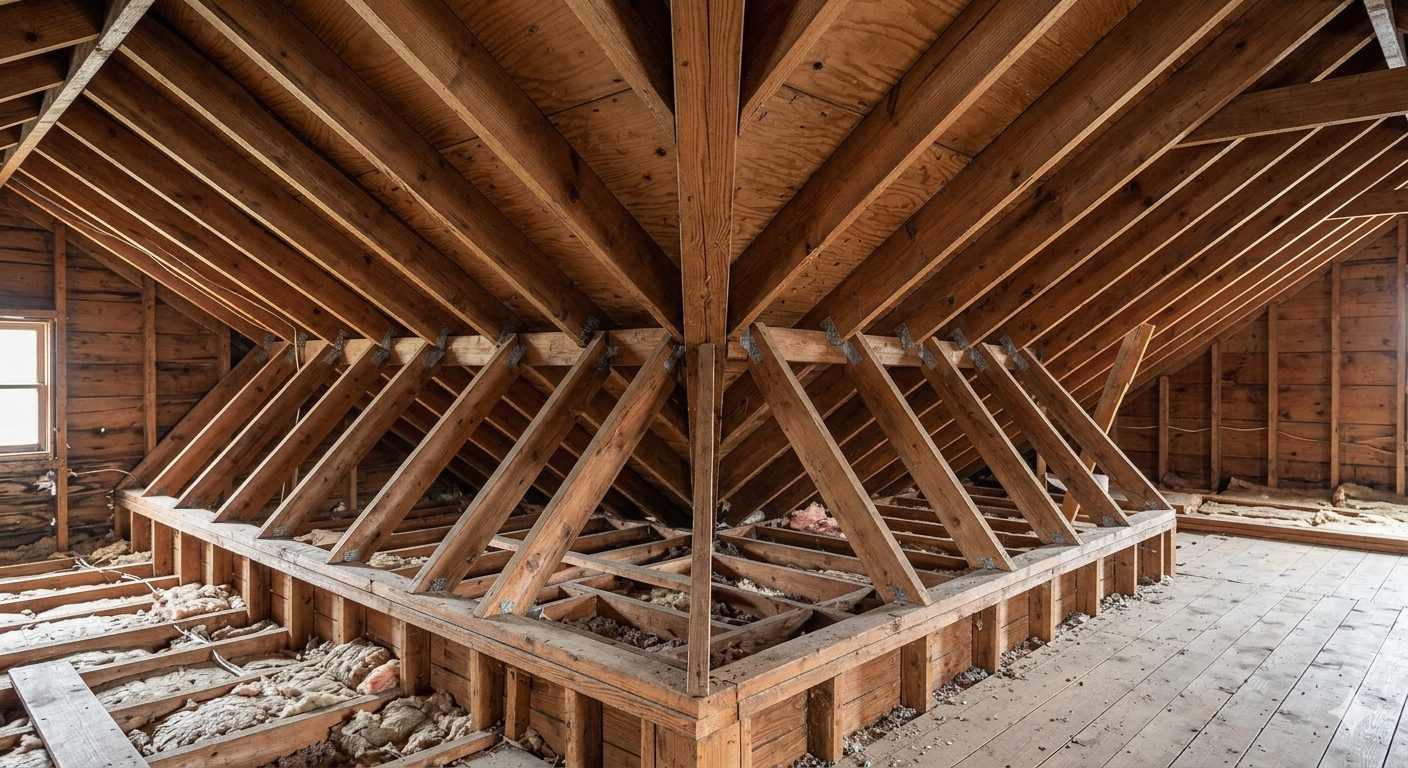
Roof rafters are the sloped structural beams that run from the ridge of a roof down to the exterior walls, forming the triangular framework that holds up the roof covering and distributes weight evenly across the building.
These wooden beams work together with ridge boards and collar ties to create a stable skeleton that resists snow loads and wind pressure. Roof rafters are typically spaced sixteen or twenty-four inches apart, and their size depends on the roofing material, the local climate, and the roof’s pitch.
Homeowners often only think about rafters when something goes wrong, such as sagging, cracking, or visible water stains on the ceiling.
This article covers what roof rafters are, how they differ from trusses, the names used for different rafter types, their functions, and what they look like so property owners can spot issues before they become costly.
What Is the Rafter of a Roof?
A rafter is a single structural beam, usually made of dimensional lumber, that runs at an angle from the ridge of the roof down to the eaves or wall plate. Each rafter works in pairs with a matching rafter on the opposite slope, forming the inverted V shape that gives a pitched roof its triangular profile.
The angle of the rafter is set by the roof pitch, which is the ratio of vertical rise to horizontal run, and this angle affects how much weight the rafter can bear and how snow sheds off the surface.
Rafters are commonly cut from two-by-six, two-by-eight, or two-by-ten boards, with the exact size depending on the span, the anticipated snow load, and the roofing material used.
Rafters do not work alone; they rely on the ridge board at the top, the wall plate at the bottom, and often collar ties that prevent the walls from spreading outward.
In Winnipeg and similar cold-climate regions, rafters must be sized to handle heavy seasonal snow accumulation, which often means local codes require larger or more closely spaced rafters than milder climates need.
What Is the Difference Between Rafters and Trusses?
Rafters and trusses both support a roof, but they differ in design and installation. Rafters are individual beams cut and assembled on-site by carpenters, which allows flexibility for custom rooflines and vaulted ceilings. Trusses are prefabricated triangular units built in a factory and lifted into place, which is much faster to install.
The internal webbing inside a truss distributes weight through triangular shapes, making trusses more material-efficient than the solid beams used in rafter construction.
Rafters typically leave more usable attic space, since the open framework creates room above the ceiling joists, while truss bracing often limits that storage potential. Rafters also require more skilled labor and time, while trusses cut labor hours but add factory and transport costs.
| Feature | Roof Rafters | Roof Trusses |
| Construction Method | Built on-site by carpenters | Prefabricated and delivered ready to install |
| Installation Time | Longer | Shorter |
| Attic Space | More open, usable space | Often reduced by internal webbing |
| Design Flexibility | Highly flexible | Standardized shapes |
| Labor Requirement | Skilled on-site carpentry | Less on-site labor, more engineering |
Homeowners choosing between the two are usually weighing custom architectural detail and attic storage, which favors rafters, against speed and cost predictability, which favors trusses.
What Are Roof Rafters Called?
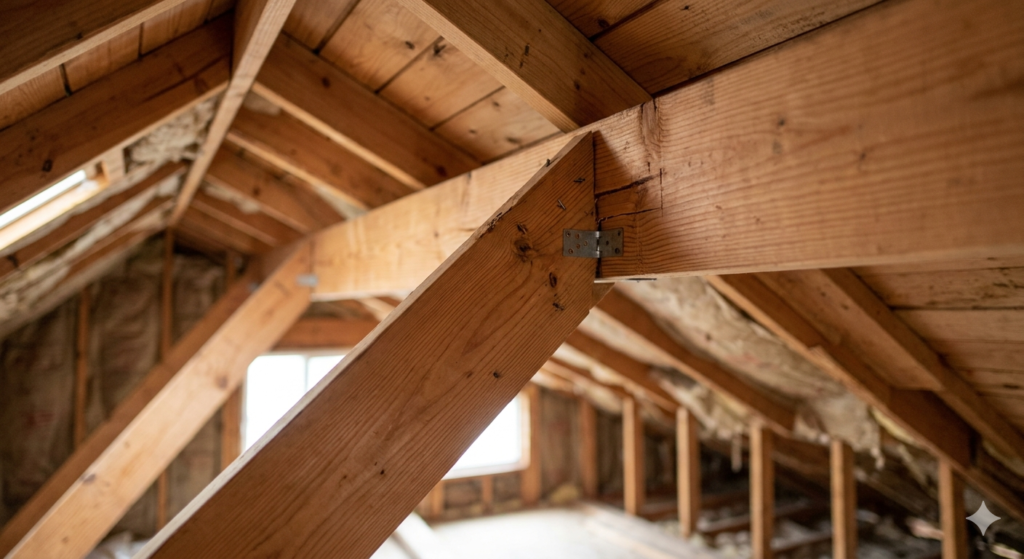
Roof rafters go by different names depending on their location in the framing system. Common rafters run straight from the ridge board to the wall plate and form the basic repeating structure of a gable roof. Hip rafters sit at the corners of a hip roof, running diagonally from the ridge to the corner and carrying more load than common rafters.
Valley rafters sit at the internal angle where two roof sections meet, an area prone to water pooling. Jack rafters are shorter pieces that run between a hip or valley rafter and the wall plate, cut at varying lengths to keep the roof slope consistent.
The ridge board is sometimes mistaken for a rafter, but it is a separate horizontal member at the peak. Collar ties are horizontal boards connecting opposing rafters to resist spreading forces on the walls.
Knowing these names helps when a contractor identifies which type of rafter is damaged, since repairing a common rafter is generally simpler than replacing a hip or valley rafter.
What Are Roof Rafters Used For?
Roof rafters create the sloped framework that supports the roof deck, the plywood or oriented strand board layer that holds shingles or metal panels. Rafters distribute the weight of the roofing material, accumulated snow, rainwater, and anyone walking on the roof, spreading that load down to the exterior walls and into the foundation.
Rafters also define the pitch and shape of the roof, which affects how efficiently water and snow shed off the surface. The spacing between rafters often houses insulation baffles and ventilation channels that allow air to flow from the eaves to the ridge, preventing moisture buildup and ice damming during Winnipeg winters.
Rafters provide attachment points for ceiling drywall from below, and in vaulted ceiling designs, exposed rafters can become a visible architectural feature.
Core Functions of Roof Rafters
- Structural Support: Rafters bear the weight of the roof deck and environmental loads, transferring it safely to the walls.
- Pitch Definition: The angle and length of rafters determine the roof’s slope and drainage efficiency.
- Ventilation Pathways: Spacing between rafters accommodates airflow from soffit to ridge vent.
- Insulation Support: Rafters create cavities for insulation that regulate attic temperature.
- Ceiling Attachment: The underside of rafters supports drywall or other ceiling finishes.
- Architectural Detail: Exposed rafters add visual character in open ceiling designs.
Even minor rafter damage should never be ignored, since a compromised rafter affects ventilation and ceiling structure as well as the roof surface.
What Do Roof Rafters Look Like?
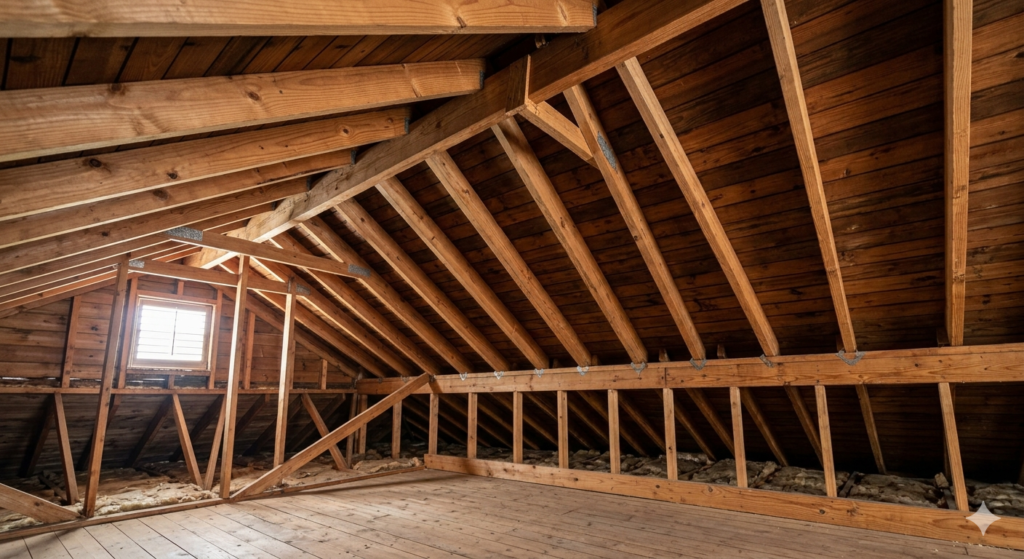
Roof rafters appear as long, straight beams of dimensional lumber, commonly cut from spruce, pine, or fir, with a cross-section ranging from two inches by six inches up to two inches by twelve inches. From inside an unfinished attic, rafters run diagonally from the peak down to the outer walls in an evenly spaced, ladder-like pattern.
A healthy rafter shows uniform color, with no dark staining, soft spots, or visible cracking, and a consistent wood grain. At the top, rafters meet the ridge board, creating the peak silhouette seen from outside the home. Near the bottom, rafters rest on the wall plate, often secured with metal hurricane ties that resist uplift during high winds.
In homes with finished ceilings, rafters are usually hidden behind drywall and only become visible during an attic inspection or renovation. Warning signs of a compromised rafter include visible sagging, dark streaking from water infiltration, soft or crumbling wood texture, and small holes suggesting insect activity.
Why Does Rafter Condition Matter for Long-Term Roof Performance?
Because rafters carry the structural load of the roof, even one weakened rafter can place added stress on neighboring rafters, creating a cascading effect across the framing system.
Water intrusion from leaks or ice damming is one of the most common threats, since prolonged moisture causes wood to rot and eventually fail under snow or wind loads.
Pest infestations are another risk, as wood-boring insects can hollow out a rafter from the inside while it still looks intact on the surface. Poor attic ventilation accelerates deterioration too, since trapped moisture condenses on the roof deck and drips onto the rafters over time.
Annual inspection of the attic space gives homeowners the best chance to catch rafter problems while they remain minor.
| Common Rafter Issue | Likely Cause | Recommended Next Step |
| Visible sagging | Excessive load or moisture exposure | Schedule a structural inspection promptly |
| Dark streaking on wood | Water infiltration or ice damming | Repair the source of the leak immediately |
| Soft, crumbling texture | Long-term rot from trapped moisture | Have the section assessed for replacement |
| Small holes or sawdust | Wood-boring insect activity | Arrange a pest and structural review |
| Cracking sounds or splits | Overloading or improper installation | Consult a roofing professional before further use |
Addressing rafter issues proactively almost always saves homeowners money, since catching a problem early is far cheaper than waiting until the rafter fails.
Things To Know About Roof Rafters
Rafter sizing is governed by local building codes that account for snow load and wind exposure, meaning a rafter system suited to one climate may be inadequate for Winnipeg’s heavy snow conditions. Not all rafter damage is visible from the attic side, since rot can begin on the outer surface where the rafter meets the roof deck.
Removing or modifying rafters without temporary structural support in place can create serious safety hazards, since rafters depend on their connections to the ridge board and wall plate for stability.
Rafter spacing also affects how insulation fits and how much weight the ceiling below can support. Anyone planning an attic conversion or cutting into existing rafters should consult a qualified professional first, since improper changes can void warranties and create lasting structural weaknesses.
Which Approach Is Best for Addressing Roof Rafter Concerns?
The right approach depends on the specific issue, the home’s age, and the scope of work involved. For minor cosmetic concerns like slight discoloration without softness, a simple inspection paired with better attic ventilation is often enough to stop the problem from progressing.
When sagging, cracking, or confirmed rot is present, a more involved repair is needed, often sistering a new beam alongside the damaged rafter to restore strength without full removal.
When damage is extensive across multiple rafters, full replacement of the framing members is the safest long-term option, even though it requires more labor and temporary disruption to the roofline.
For new construction, the choice between rafters and trusses should be guided by priorities around attic usability, architectural flexibility, and timeline. Because every rafter problem involves a unique combination of factors, a professional, hands-on assessment is the most reliable way to determine the right path.
Roof rafters in new residential construction often require this kind of individualized evaluation to match the framing with both design and local climate demands.
Conclusion: Keeping Your Roof Rafters Strong for Years to Come
Roof rafters form the backbone of every pitched roof, quietly supporting roofing materials and protecting everything beneath them. Understanding what a rafter is, how it differs from a truss, the names used for different rafter types, and what healthy versus damaged rafters look like helps property owners catch problems early.
Whether dealing with roof rafters beneath an aging shingle roof or planning a larger renovation, the goal stays the same: protecting the structural integrity of the home.
Because pricing for rafter repair varies based on the extent of damage and lumber required, it is best to contact Zega Roofing directly for an accurate assessment tailored to your situation.
With a trusted local team backing every commercial and residential roof rafters inspection, homeowners across Winnipeg can move forward knowing their roof’s framework is sound.
Frequently Asked Questions About Roof Rafters
What is the rafter of a roof?
A rafter is a sloped structural beam running from the roof’s ridge down to the wall plate, forming the framework that supports the roof covering. Rafters work in pairs to create the triangular shape of a pitched roof and bear the combined weight of roofing materials, snow, and wind.
What is the difference between rafters and trusses?
Rafters are built piece by piece on-site, while trusses are prefabricated off-site and installed as complete units. Rafters generally allow more attic space and design flexibility, whereas trusses install faster and use material more efficiently.
What are roof rafters called?
Common names include common rafters, hip rafters, valley rafters, and jack rafters, each named for their position within the roof framework. Common rafters run along the main slope, while hip and valley rafters handle the angled sections where roof planes meet.
What are roof rafters used for?
Rafters support the roof deck, distribute structural loads, define the roof’s pitch, and create space for insulation and ventilation. They also provide attachment points for ceiling materials and, in vaulted designs, serve as a visible architectural feature.
What do roof rafters look like?
Rafters appear as long, straight wooden beams spaced evenly apart, running diagonally from the ridge board to the wall plate. Healthy rafters show consistent wood grain without staining or sagging, while damaged rafters often display discoloration or cracking.